A startup may spend months developing a product, designing a logo, building a website, and preparing for launch. However, if the business does not secure its brand early, another party may register a similar name, challenge its use, or force the company to rebrand. Working with a trademark lawyer for startups can help founders assess legal risks, search for conflicting marks, prepare accurate applications, and create a trademark strategy that supports funding, expansion, licensing, and long-term growth.
What Does a Trademark Lawyer for Startups Do?
Atrademark lawyer for startups helps early-stage businesses protect the names, logos, slogans, product identifiers, and commercial signs associated with their brands.
Trademark work for startups often involves more than filing an application. A lawyer may help founders determine what should be protected, who should own the trademark, where applications should be filed, and whether the proposed mark is legally available.
Typical services may include:
- Reviewing business and product names;
- Conducting trademark searches;
- Assessing registration risks;
- Selecting appropriate trademark classes;
- Drafting goods and services descriptions;
- Preparing and filing applications;
- Responding to office actions;
- Handling oppositions;
- Reviewing license and distribution agreements;
- Managing international trademark filings;
- Monitoring competing applications;
- Supporting trademark enforcement.
The lawyer’s role is to connect legal protection with the startup’s commercial strategy.

Why Trademark Protection Matters for Startups
A startup’s brand may become one of its most valuable assets. Customers, investors, employees, and partners often identify the company through its name and visual identity.
Without trademark protection, the startup may struggle to prevent competitors or unrelated parties from using confusingly similar branding.
Avoiding Costly Rebranding
Rebranding can be expensive at any stage, but it can be especially damaging for a young company.
A startup may need to replace:
- Product packaging;
- Websites;
- Mobile applications;
- Advertising materials;
- Domain names;
- Social media accounts;
- Business cards;
- Store signs;
- Sales presentations;
- Investor documents.
The company may also lose customer recognition and online visibility.
A trademark search before launch can identify legal conflicts before the startup commits substantial resources to a name.
Reducing the Risk of Trademark Disputes
A startup may unknowingly choose a name that is already registered or used by another business.
The earlier owner may send a cease-and-desist letter, oppose the startup’s application, file an infringement claim, or ask an online platform to remove the startup’s content.
Legal disputes can consume time and resources that should be used for product development and growth.
Early legal review helps founders understand whether the proposed brand presents low, moderate, or high risk.
Supporting Investment and Due Diligence
Investors often examine intellectual property ownership during due diligence.
They may ask whether:
- The company owns its brand;
- Trademark applications have been filed;
- The correct legal entity is the owner;
- There are known conflicts;
- Founders or contractors hold rights personally;
- The company has international protection;
- Licensing arrangements are properly documented.
A clear trademark portfolio can reduce uncertainty and support financing discussions.
Protecting Market Expansion
A startup may begin locally but quickly expand through e-commerce, software platforms, distributors, or international partnerships.
A domestic trademark registration usually does not create protection worldwide.
A startup planning international growth should identify priority countries early and coordinate filings before the brand becomes widely visible.
When Should a Startup Contact a Trademark Lawyer?
The best time to seek trademark advice is before the brand is publicly launched.
Startups should consider legal review when:
- Choosing a company name;
- Naming a new product;
- Designing a logo;
- Registering a domain name;
- Preparing a mobile application;
- Launching an online platform;
- Entering an accelerator;
- Seeking investment;
- Hiring distributors;
- Expanding internationally;
- Licensing technology;
- Beginning franchising.
Waiting until a trademark dispute arises usually creates more risk and cost.
A short legal review during the naming stage can be more valuable than a complex dispute after launch.
Trademark Search for Startup Brands
A trademark search is one of the most important steps before filing or using a brand.
Exact-Match Searches
The search begins by checking whether the same name has already been filed or registered.
An identical mark may create a serious obstacle when it covers the same or related goods and services.
However, exact matches are only part of the analysis.
Similar Trademark Searches
Trademark conflicts often involve names that are similar rather than identical.
A search may need to consider:
- Similar spelling;
- Similar pronunciation;
- Shared dominant words;
- Abbreviations;
- Plural and singular forms;
- Translations;
- Transliteration;
- Related meanings;
- Similar logos;
- Common variations.
Changing one letter may not eliminate legal risk if consumers would still view the marks as similar.
Related Goods and Services
Trademark conflict depends on both the marks and the products or services.
Two identical marks may sometimes coexist in unrelated industries. By contrast, similar marks may conflict when the goods, customers, or distribution channels overlap.
A startup trademark lawyer may assess:
- Product type;
- Intended customers;
- Sales channels;
- Market positioning;
- Industry relationship;
- Business expansion plans.
This analysis is more useful than relying only on class numbers.
Choosing the Right Trademark
Not every business name is equally strong from a trademark perspective.
Generic Terms
Generic terms name the product or service itself.
For example, a company selling accounting software would usually have difficulty claiming exclusive trademark rights in the term “accounting software.”
Generic terms generally cannot function as strong trademarks.
Descriptive Marks
Descriptive marks directly describe a feature, quality, function, or purpose of the product.
These marks may be difficult to register unless the owner can show that consumers have learned to recognize the term as a brand.
Startups often choose descriptive names because they are easy to understand, but those names may provide weaker legal protection.
Suggestive Marks
Suggestive marks hint at a product benefit or characteristic without directly describing it.
They can be more distinctive and may provide a better balance between marketing value and legal protection.
Arbitrary Marks
An arbitrary mark uses a common word in an unrelated context.
Because the word does not describe the product, it may be easier to protect.
Invented Marks
Invented or coined words are often highly distinctive because they have no ordinary meaning.
They may require more marketing effort, but they can provide stronger trademark protection.
A trademark lawyer can help founders compare legal strength, marketing value, and registration risk before selecting a name.
What Should a Startup Register?
A startup does not always need to register every brand element immediately.
The filing strategy should prioritize the most commercially important assets.
Company Name
The main company or platform name is often the first priority.
However, registering a company name with a business authority does not necessarily create trademark rights.
Trademark registration may still be required.
Product Name
A startup may use a company name and separate product names.
Important products may require their own applications, especially when they are marketed independently.
Logo
A logo registration protects the visual design shown in the application.
If the startup expects to redesign the logo, a word mark may offer more flexible protection for the name.
Slogan
A slogan may be registrable when it functions as a distinctive source identifier rather than ordinary advertising language.
App or Software Name
Technology startups should consider protecting app names, software platforms, online services, and digital products.
App store and domain name availability do not guarantee trademark availability.
Word Mark or Logo: Which Should a Startup File First?
A word mark protects the verbal element of a brand without being limited to a particular design.
A logo mark protects the specific visual presentation.
For many startups, the word mark is a higher priority because the name may remain consistent even when the design changes.
A separate logo application may also be appropriate when the visual identity is important and distinctive.
The decision depends on:
- Budget;
- Brand structure;
- Use of the mark;
- Likelihood of redesign;
- Market importance;
- Expansion plans.
A startup with limited resources may prioritize the word mark and add logo protection later.
Identifying the Correct Trademark Owner
Ownership mistakes can create serious problems for startups.
A trademark may be filed in the name of:
- A founder;
- A holding company;
- The operating company;
- A foreign affiliate;
- A distributor;
- A contractor.
The correct owner should normally be the entity that controls the brand and conducts the relevant business.
Problems may arise when a founder files personally and later transfers the rights to the company, especially during investment, restructuring, or acquisition.
The ownership structure should be reviewed before filing to avoid unnecessary assignments and disputes.
Selecting Trademark Classes
Trademark applications organize goods and services into classes.
The Nice Classification contains 45 classes, including goods in Classes 1 to 34 and services in Classes 35 to 45.
A startup may need more than one class.
For example, a technology business may require protection for:
- Downloadable software;
- Software-as-a-service;
- Online retail services;
- Business consulting;
- Telecommunications;
- Education services;
- Hardware products.
The classes should reflect current activities and realistic growth plans.
Filing too narrowly may leave important services unprotected. Filing too broadly may increase fees and create unnecessary use obligations.
The Trademark Registration Process for Startups
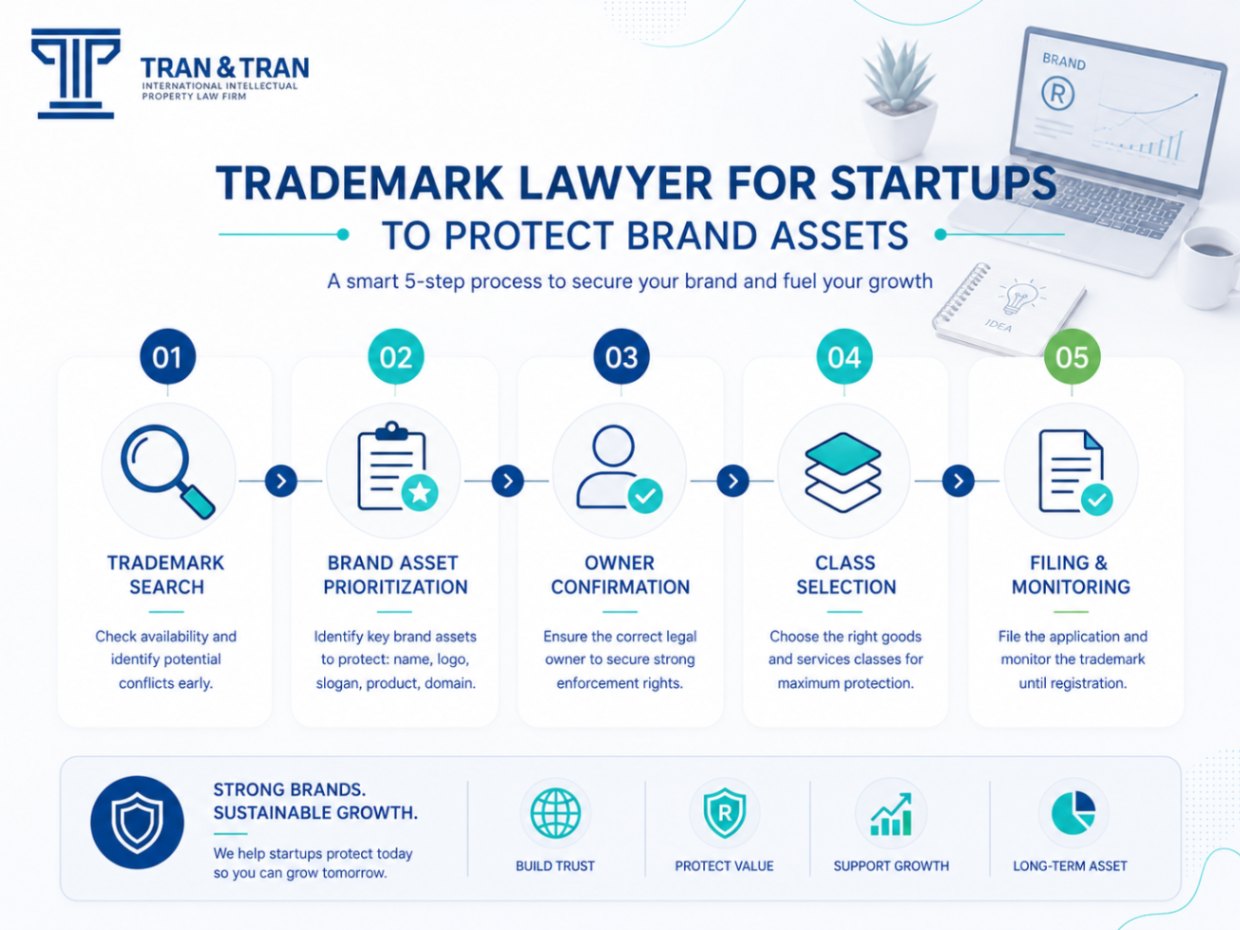
Step 1: Define the Brand
The startup should identify the exact name, logo, slogan, or product mark it wants to protect.
Different versions may require separate applications.
Step 2: Conduct a Search
The proposed mark should be searched for identical and similar earlier rights.
The search should cover relevant countries, goods, services, and commercial sources.
Step 3: Assess Registrability
The lawyer reviews whether the mark is distinctive, descriptive, generic, misleading, or likely to conflict with earlier rights.
Step 4: Confirm Ownership
The appropriate legal entity is identified as the applicant.
This should align with the startup’s corporate and investment structure.
Step 5: Prepare the Specification
The goods and services are described clearly and placed in the appropriate classes.
Step 6: File the Application
The application is submitted to the relevant national, regional, or international trademark authority.
Step 7: Complete Examination
The trademark office reviews the application.
It may raise objections relating to distinctiveness, similarity, classification, or formal requirements.
Step 8: Respond to Office Actions
The applicant may need to submit legal arguments, amendments, evidence, or clarification.
Deadlines should be monitored carefully.
Step 9: Publication and Opposition
The application may be published for third-party opposition.
An earlier rights holder may challenge the application.
Step 10: Registration and Maintenance
If the application succeeds, the trademark is registered.
The owner must then manage renewals, ownership changes, use requirements, licensing, and enforcement.
Common Trademark Mistakes Made by Startups
Choosing a Name Without Searching
Domain availability and company registration do not confirm trademark availability.
Filing Too Late
Public launch can expose the brand to copycats and third-party filings.
Filing in the Founder’s Name
This may complicate investment, licensing, and corporate restructuring.
Selecting the Wrong Classes
The application may fail to protect the startup’s actual products or services.
Registering Only the Logo
The company may have limited protection if the logo changes.
Ignoring International Markets
A domestic application may not protect the startup in overseas sales or manufacturing countries.
Assuming Registration Is Automatic
Trademark offices may raise objections or earlier owners may oppose the application.
Missing Deadlines
Failure to respond may result in refusal or abandonment.
Failing to Use the Trademark
In many countries, prolonged non-use may make a registration vulnerable to cancellation.
Trademark Protection for International Startups
Startups that sell online may reach international customers before they have a physical presence abroad.
This can create unexpected trademark exposure.
Priority countries may include:
- Main customer markets;
- Investor markets;
- Manufacturing locations;
- Countries with distributors;
- App store markets;
- E-commerce territories;
- High-risk counterfeiting jurisdictions.
A startup may use national applications, regional systems, the Madrid System, or a combination of filing routes.
The best strategy depends on budget, growth plans, risk, and market importance.
Trademark Issues During Fundraising
Investors may review the startup’s brand ownership before committing capital.
Common due diligence questions include:
- Who owns the trademarks?
- Have applications been filed?
- Are the trademarks registered?
- Are there outstanding objections?
- Are founders or employees using similar personal brands?
- Are licenses documented?
- Are international markets protected?
- Are there known disputes?
A startup should maintain organized records, including applications, certificates, assignments, licenses, correspondence, and search reports.
Trademark Issues in Founder and Contractor Agreements
Brand ownership should also be addressed in contracts.
A designer may create the logo, but that does not always mean the startup automatically owns every associated right.
Agreements with founders, employees, developers, agencies, and contractors should clearly address:
- Ownership of creative work;
- Assignment of intellectual property;
- Use of company names;
- Confidentiality;
- Rights after termination;
- Cooperation with trademark filings.
Clear contracts help prevent ownership disputes later.
How Much Does a Trademark Lawyer for Startups Cost?
There is no fixed price for atrademark lawyer for startups.
Costs may depend on:
- Number of trademarks;
- Number of classes;
- Search scope;
- Filing country;
- Official fees;
- Legal review;
- Office actions;
- Opposition proceedings;
- International filings;
- Portfolio management.
A basic application may cost less than a multi-country filing or a complex dispute.
Startups should request a cost estimate that separates official fees from legal fees and explains what services are included.
The lowest price may not provide the best value if the service excludes searching, legal analysis, specification drafting, monitoring, or office action support.
How to Choose a Trademark Lawyer for a Startup
Founders should choose a lawyer who understands both trademark law and startup business needs.
Useful questions include:
- Does the service include a trademark search?
- Will the lawyer assess legal risk?
- Who will draft the goods and services?
- Is ownership structure reviewed?
- Are international filings supported?
- Are office actions included?
- How are costs calculated?
- Will deadlines be monitored?
- Is post-registration support available?
Clear communication is especially important for startups that need to balance legal protection with limited budgets.
Conclusion
Atrademark lawyer for startups helps founders protect one of their most important business assets: the brand.
Professional support can help a startup select a stronger trademark, identify earlier rights, file in the correct name, choose appropriate classes, respond to objections, and plan international protection.
Trademark planning should begin before public launch, fundraising, distribution, or overseas expansion.
Early action can reduce the risk of rebranding, infringement claims, bad-faith filings, and ownership disputes.
For startups, trademark registration is not simply a legal formality. It is part of building a scalable, investable, and defensible business.
Frequently Asked Questions
What does a trademark lawyer for startups do?
A trademark lawyer helps startups search, assess, file, monitor, manage, and enforce trademarks.
When should a startup register its trademark?
Ideally, before publicly launching the brand, releasing a product, seeking investment, or entering new markets.
Is registering a company name enough?
No. Company registration and trademark registration serve different legal purposes.
Should a startup register a word mark or logo?
Many startups prioritize the word mark because it protects the name independently of design. A logo may also require separate protection.
Is a trademark search necessary?
A search is strongly recommended because it helps identify earlier rights and reduce infringement or refusal risks.
Can the founder own the trademark personally?
It is possible, but personal ownership may create problems during investment, restructuring, or sale. The ownership structure should be reviewed carefully.
How many classes should a startup file?
The number depends on the startup’s current products, services, and realistic expansion plans.
Does a domestic trademark protect the brand internationally?
No. Trademark rights are territorial, so protection must be obtained in relevant foreign countries or regions.
How long does trademark registration take?
The timeline varies by jurisdiction, examination process, office actions, and opposition proceedings.
What happens after registration?
The startup should monitor renewals, ownership information, evidence of use, licensing arrangements, and unauthorized use.